
Price Caps in Home Care: Lessons from 2023

In the periods after price caps are introduced, there are predictable changes in pricing strategy and market dynamics. We unpack the key opportunities for providers and share insights into how to prepare for future price caps.
The January 2023 Home Care Package fee caps were introduced to improve value for older Australians by constraining management fees. Looking at the published pricing data since, we see a more complex picture.
Our review of published Home Care Package pricing from 2022 Q2 to 2025 Q3 shows basket prices increased after capping. Personal care and nursing rose in line with what we would expect following the aged care wage decision and the subsidy uplift that followed. Management fees are where we see something different. Care management and package management stepped up in 2023 Q3, did not ease off, and settled at a higher level.
Management fees were the fees the reform was designed to contain. In our view, when the targeted fees step up and hold the higher ground, it is worth asking what role the cap itself played in the repricing.
The market moved toward the cap after it was introduced
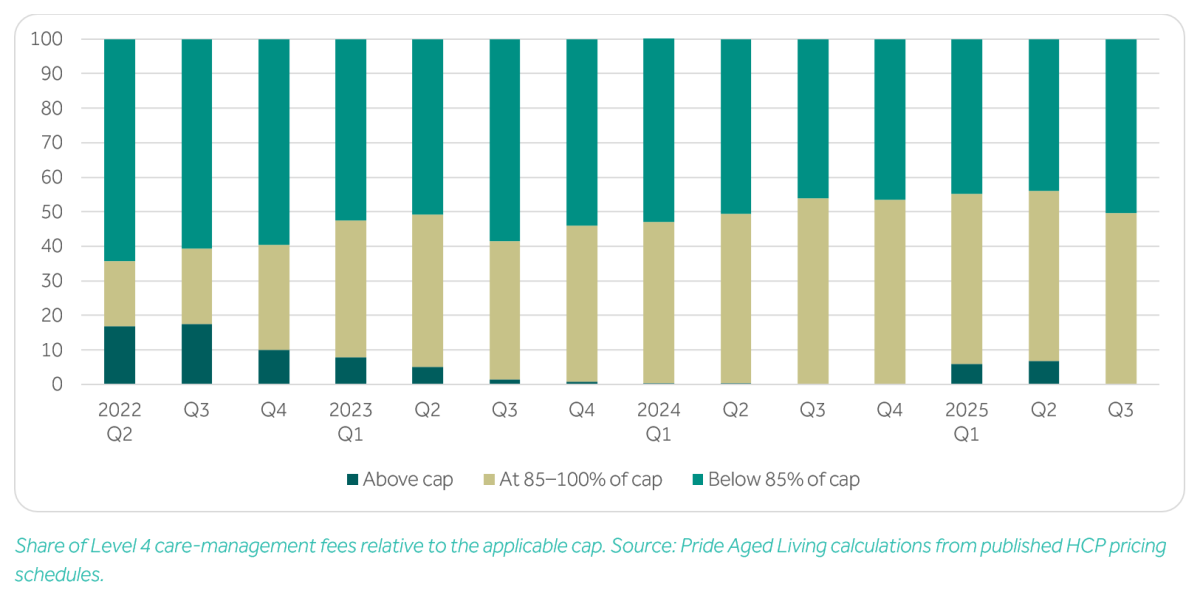
By 2023 Q2, the market was already converging toward the future care-management cap in response to the announced reform. Only a minority of providers were pricing above it, but a growing share were pricing just below it. The proportion sitting within 85% to 100% of the cap rose from 18.9% in 2022 Q2 to 44.2% in 2023 Q2.
The evidence shows that the published price caused prices to converge. A small number of overpriced services were lowered, however a much larger group of underpriced services were increased. The data shows the published maximum became an accepted market reference point.
Management fees stepped up and stayed there
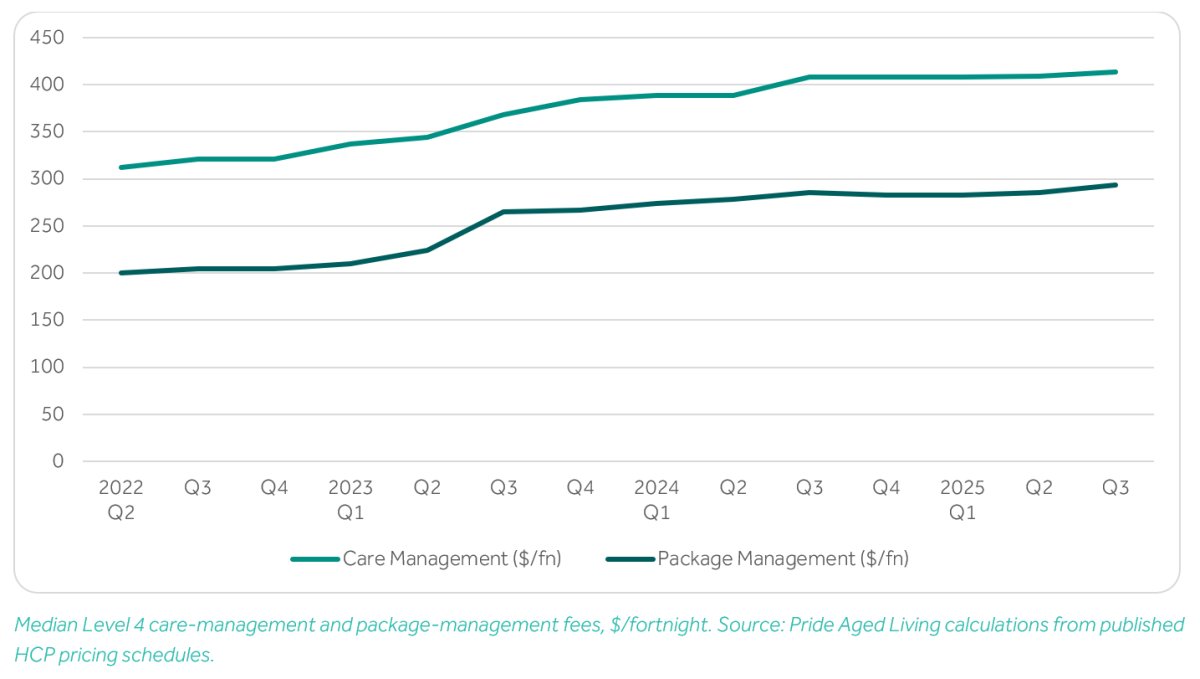
The 2023 Q3 price reviews are where we see the step up. Between 2023 Q2 and 2023 Q3, the median Level 4 care-management fee rose from $344.40 to $367.78 per fortnight. Package management rose from $224.00 to $265.30. Package management moved furthest: an 18.4% increase in a single quarter and 29.8% across the year.
Personal care and nursing also rose over this period. Those increases track with the aged care wage decision and the associated subsidy uplift. Management fees sit in a different category. They did not face the same direct wage shock, yet they also stepped up and held the higher ground. By 2025 Q3, the median Level 4 care-management fee had reached $413.00 and package management $293.30.
This is the clearest pattern in the dataset. The cap did not shape management pricing downward; rather, it appears to have provided a reference point against which repricing occurred.
What changed in the 2023 Q2→Q3 repricing
| Q3 2022 | Q3 2023 | YoY % | Q3 2024 | YoY % | Q3 2025 | YoY % | |
|---|---|---|---|---|---|---|---|
| Personal Care ($/hr) | $60.00 | $70.00 | +16.7% | $75.00 | +7.1% | $79.95 | +6.6% |
| Nursing ($/hr) | $101.85 | $119.95 | +17.8% | $126.00 | +5.0% | $133.98 | +6.3% |
| Care Mgmt L4 ($/fn) | $320.70 | $367.78 | +14.7% | $408.10 | +11.0% | $413.00 | +1.2% |
| Pkg Mgmt L4 ($/fn) | $204.32 | $265.30 | +29.8% | $285.74 | +7.7% | $293.30 | +2.6% |
Selected median price movements around the Q3 2023 repricing point. Source: Pride Aged Living calculations from published HCP pricing schedules.
Basket prices rose because providers repriced below the cap
The matched-provider evidence points the same way. Between 2023 Q2 and 2023 Q3, 43.9% of outlets below the Level 4 care-management cap increased their fee. For package management, 48.7% of those below the cap increased their fee. Among outlets more than 20% below the cap, the share raising prices was higher again.
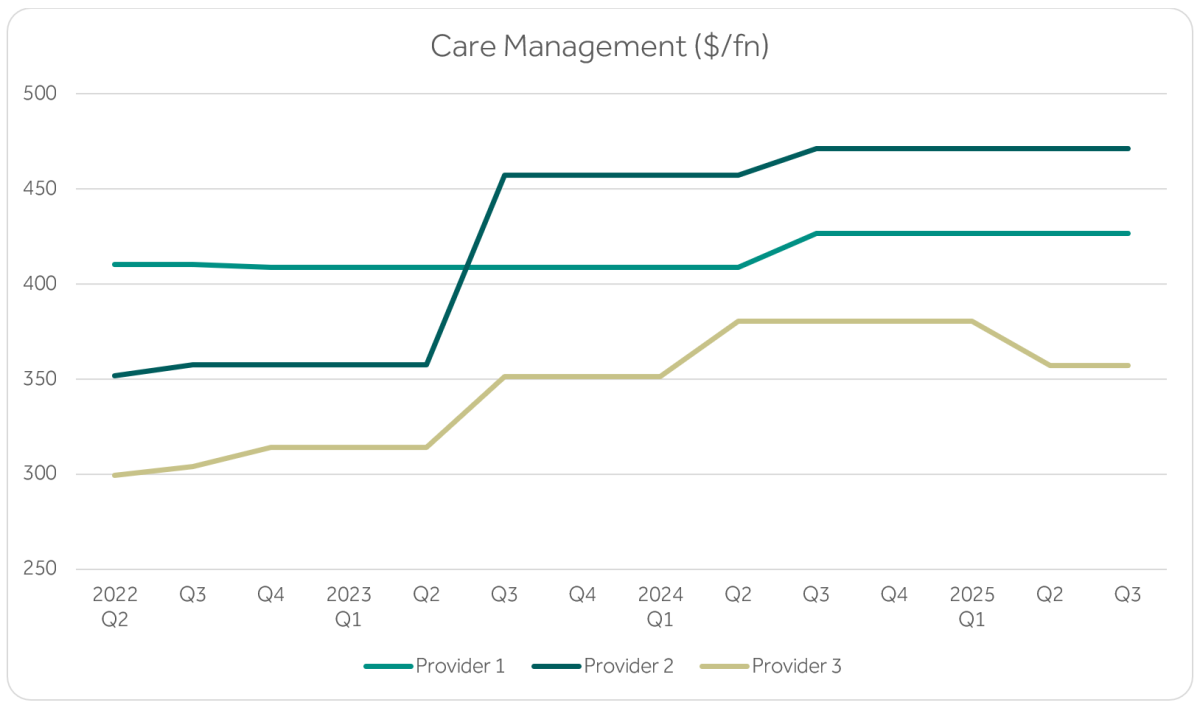
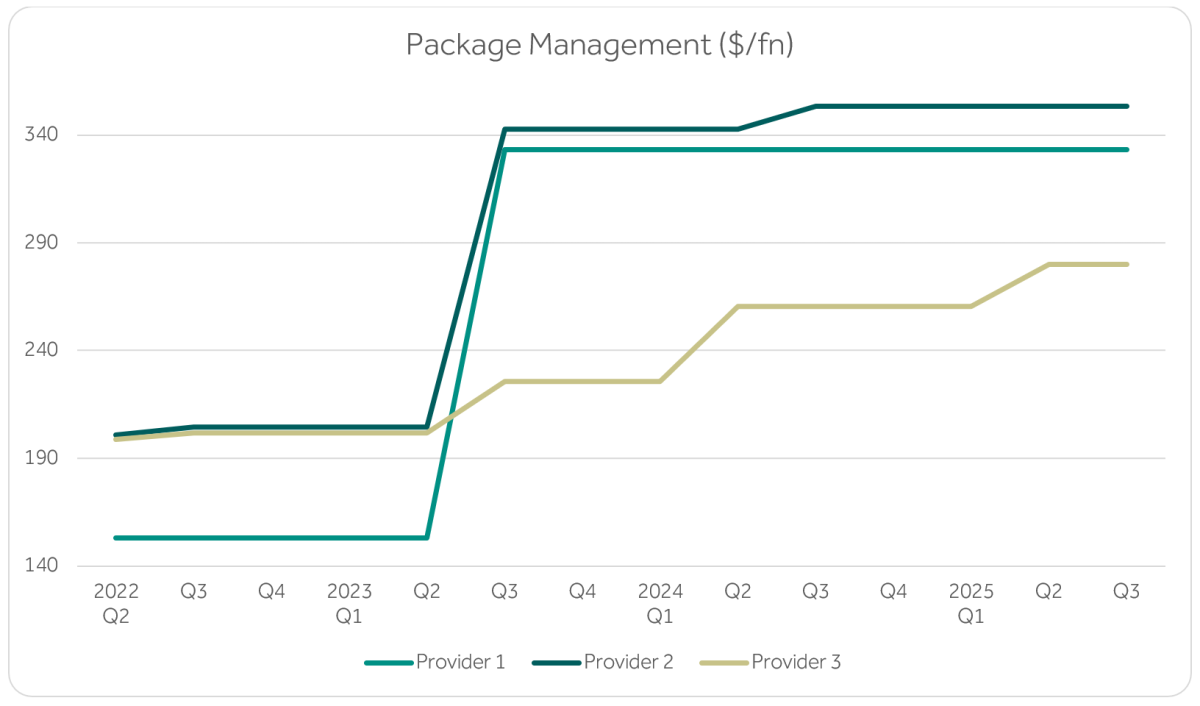
Management-fee movements for three of the largest providers, anonymised. Source: Pride Aged Living calculations from published HCP pricing schedules.
What this means for Support at Home
The HCP experience is worth carrying into sector conversations about price regulation. The evidence we see is that basket prices rose after the caps took effect. Economic research has long observed that caps in multi-part markets can become focal points for repricing. In home care, that pattern is visible in the data.
The HCP data is a reminder that the effect of a cap depends on how the market behaves around it. That makes it worth testing assumptions about pricing behaviour, basket composition and cost recovery before the new framework takes effect, rather than after.
While organisations with different footprints and different characteristics moved in the same direction over the same period, there are subtle differences in the optimal approach for every organisation. We recommend that providers prepare a pricing strategy in advance, so they can respond promptly when pricing caps are announced.
If you’d like to explore what a cap would mean for your organisation, we’d be happy to have a conversation about your approach to pricing strategy.
Introducing our 2-part CHSP webinar series with Ageing Australia:

Webinar 1 - Operational Performance and Financial Viability
7 May 2026, 12-1 pm (AEST)
Webinar 2 - Strategic Options: Transition, Partner or Exit
10 June 2026, 12-1 pm (AEST)
Speaker:
Jason Howie
This two-part executive webinar series provides an overview of the challenges and options for CHSP providers preparing to transition to the Support at Home funding program, currently scheduled for no earlier than July 2027.
CHSP organisations without existing Support at Home operations are expected to transform their service models to participate in the more complex Support at Home marketplace. This process will involve both opportunities and challenges. The administration of Support at Home is complex, requires significant change management regarding customer experience, and carries more financial risk. At the same time, transforming the business will give access to the much larger, more profitable and more flexible Support at Home market.
Webinar 1 – Operational Performance and Financial Viability – 7 May 2026
The first webinar will look at what organisations should do to optimise their operational performance and ensure they remain financially viable under the new funding structure. It will include a high-level overview of the work required to transform the organisation to the new funding model.
Webinar 2 – Strategic Options: Transition, Partner or Exit – 10 June 2026
The second webinar discusses the nature of the reform and the operational and strategic options available to organisations that are not sure they wish to make the transition, while protecting their staff and clients.
The outcomes are:
- Which levers are available for improving the performance of existing CHSP operations
- How to transform a CHSP provider to a Support at Home provider
- A high-level understanding of how Support at Home providers operate.
- The strategic options available for CHSP providers to either expand or exit.
- Understanding of the categories of partner organisations in the marketplace and how to go about negotiating with them.
Who should attend?
These webinars are targeted towards board members, executives and operational managers responsible for standalone CHSP providers.
Learn more and register here.
To find out how we can assist your organisation with Support at Home, contact Jason.
Jason Howie
02 9068 0777
jason.howie@prideagedliving.com.au