
What 3,000 New Residents Tell Us About HELF Uptake

Most providers looking to improve HELF performance start in the same place: pricing. Understandably, when package uptake falls short of expectations, the natural response is to ask whether fees are too high.
However, our analysis of almost 3,000 new residents across 177 aged care homes suggests providers may be focusing on the wrong lever.
Across the dataset, we found examples of homes achieving 100% HELF uptake at both the highest and lowest price points. At the same time, some lower-priced offerings generated little or no uptake at all. What we're seeing is that price alone rarely explains performance. The more consistent differentiators are operational capability, staff confidence and the ability to clearly communicate value to prospective residents and their families.
For many providers, the bigger opportunity may lie in strengthening the systems, conversations and service design that sit behind the offer rather than reducing fees.
What the Data Shows
Across our analysis of almost 3,000 new residents, package uptake varied significantly between homes with comparable pricing structures.
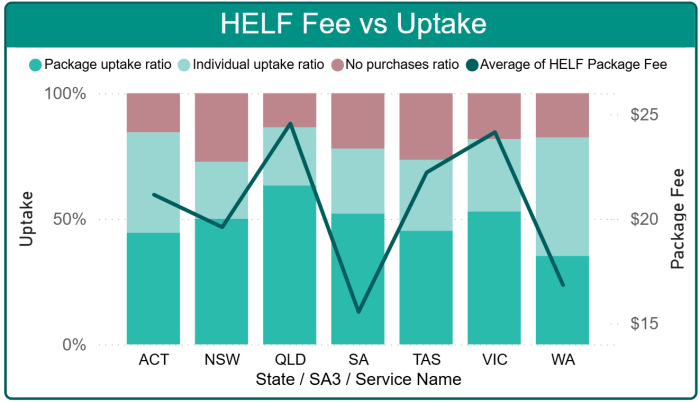
Jurisdictions with higher average fees within the data, such as Queensland and Victoria, achieved uptake rates similar to lower-fee regions, while some lower-priced homes recorded relatively modest results.
The pattern became even more apparent at a facility level. One home charging $65 per day achieved 100% package uptake, while another charging just $10.95 per day achieved the same outcome. Conversely, several homes charging less than $15 per day recorded little or no package uptake.
What High-Performing Homes Do Differently
Through our work with providers across Australia, we've observed that high-performing HELF programs share a number of common characteristics.
First, the package included services based on resident preferences rather than generic inclusions. The focus is on creating a meaningful lifestyle offering that reflects the expectations and interests of the resident cohort.
Second, HELF is introduced early. Rather than treating it as a secondary discussion after moving in, these providers position enhanced living services as part of the value proposition to move into the home.
Third, staff are confident in explaining the services and the value proposition. Conversations focus less on cost and more on outcomes, convenience, choice and quality of life.
Leadership also plays an important role. The strongest-performing homes typically have visible executive and operational support for HELF, ongoing staff education and regular performance monitoring.
By contrast, lower-performing homes often rely on passive communication, generic package structures and inconsistent messaging. In many cases, staff may understand what is included in the package but feel less confident explaining why it matters to residents and families.
HELF performance appears to improve when providers move beyond simply offering a package and instead build organisational capability around communicating its value.
Residents Are Already Demonstrating Demand
Another finding from the analysis challenges a common perception that residents may not want enhanced everyday living services.
In reality, residents are already purchasing many of these services.
The most frequently purchased individual services across the dataset included in-room television, Wi-Fi, choice of hot meals and desserts, hot breakfast options and managed bar fridge services. Technology-related services accounted for approximately 76% of the top individual purchases, with hospitality-related services making up the remainder.
If residents are already choosing these services individually, the challenge may not be generating demand. Instead, the opportunity may be to better connect that demand with the value of a packaged offering.
In many cases, residents purchasing multiple services individually may incur costs greater than the package fee itself. However, that comparison is not always clearly demonstrated when moving in and during onboarding discussions.
The providers achieving stronger uptake appear better able to bridge this gap. They help residents and families understand not only what is included, but how the package aligns with their preferences and may represent better overall value.
Operational Capability Matters More Than Geography
Another assumption we frequently hear is that HELF performance is largely driven by location, demographics or market conditions.
Our analysis suggests the picture is more nuanced.
Average package uptake across metropolitan, regional and rural homes was relatively consistent.
|
Metro |
Regional |
Rural |
|---|
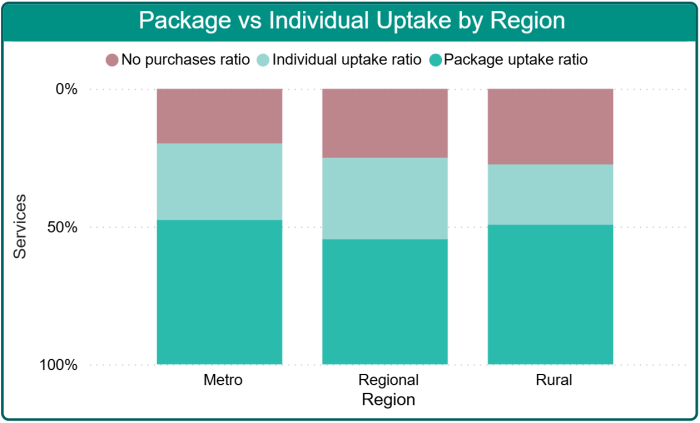
While local factors will always influence consumer behaviour, the variation between homes in similar markets is often greater than the variation between geographic categories.
This reinforces a broader observation we've seen across the sector. When comparing homes with similar pricing, service offerings and catchment characteristics, operational execution emerges as the more significant differentiator.
That is good news for providers because operational capability is something organisations can influence directly.
What This Means for Providers
For providers looking to improve HELF performance, the findings point to several practical considerations.
(Click to expand)
Thinking about implementing or optimising HELF in your organisation?
Pride Aged Living has supported providers across Australia to design, implement and improve HELF programs that enhance resident experience while supporting financial sustainability.
This analysis is based on approximately 3,000 residents who entered post 1-Nov 2025 across 177 aged care homes nationally and interviews with staff at the homes conducted by Pride Aged Living as part of its ongoing HELF implementation and support program.
To find out how we can help with Higher Everyday Living Fees, contact Megan.
Megan White
02 9068 0777
megan.white@prideagedliving.com.au